Top Solar Gear Motor Manufacturers Worldwide

Time:2026-09-17 Author:Madeline
0%

Solar power is entering a scale few equipment categories can ignore. IRENA’s Renewable Capacity Statistics 2025 recorded 585 gigawatts of new renewable capacity in 2024. Solar contributed about 452 gigawatts, representing more than three quarters of that growth. This expansion increases demand for reliable motion systems, including the Solar Gear Motor used in tracking platforms, panel adjustment units, and compact off-grid installations.

Fatih Birol, Executive Director of the International Energy Agency, called solar PV “the new king of global electricity markets.” His statement describes the market’s direction, although it does not solve every mechanical challenge. A tracker may face dust, heat, wind loads, backlash, and repeated daily movement. Small sealing failures can become costly maintenance problems. Torque ratings alone cannot reveal the full risk.

The IEA’s Renewables 2024 report expects solar PV to dominate new renewable deployment through 2030. SolarPower Europe also forecasts continued strong growth across utility-scale and distributed projects. These reports support a broader conclusion: motor suppliers must compete on durability, efficiency, control compatibility, and service support. Price still matters. It should not be the only filter.

The global market remains difficult to compare. Manufacturers use different terms for actuators, slew drives, geared motors, and tracker motors. Some published performance figures lack identical testing conditions. That weakness deserves attention. This guide examines leading Solar Gear Motor manufacturers worldwide through product design, environmental protection, operating precision, warranty clarity, and field experience. The strongest supplier may not be the cheapest. It may be the one that keeps a panel row moving after years of sun, dust, and neglected maintenance.
Top Solar Gear Motor Manufacturers Worldwide

Solar Gear Motors: Definition, Functions, and Key Applications

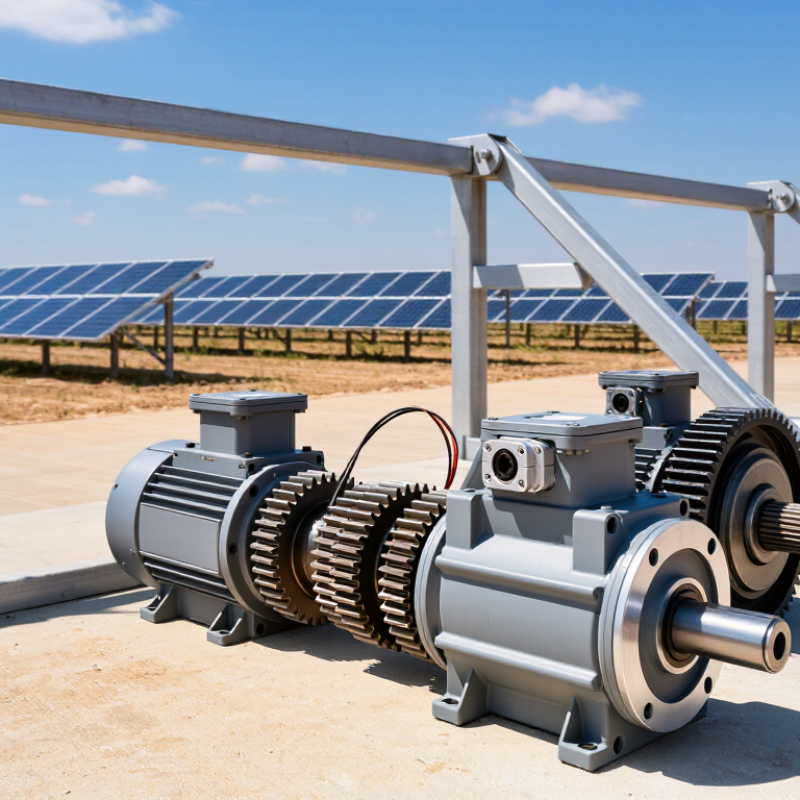
A solar gear motor combines an electric motor with a gearbox to deliver controlled rotary motion. The gearbox reduces speed and increases usable torque. This design helps solar equipment move steadily under changing outdoor conditions. In photovoltaic tracking systems, gear motors adjust panel angles throughout the day. They can also drive tilt mechanisms, mirror fields, solar pumps, and automated cleaning equipment.

In field installations, technicians check torque demand, movement frequency, wind exposure, and enclosure protection. A motor may work well in a workshop but struggle with dust, rain, heat, or freezing temperatures. Proper sizing matters. Excessive torque can damage mounting structures, while insufficient torque may cause incomplete positioning. Low backlash improves tracking accuracy. Sealed bearings and suitable lubrication support longer service intervals. Still, no gearbox is perfect.

Performance depends on the complete system. Controllers, limit switches, wiring, and mechanical alignment must cooperate. A high-efficiency motor cannot compensate for a poorly balanced panel frame. Engineers should review duty cycles, holding requirements, braking behavior, and emergency movement conditions. Corrosion-resistant materials are valuable near coastal sites. Temperature testing also deserves attention, because lubricant viscosity changes with weather. I have seen designs focus heavily on rated torque while overlooking startup current and cable losses. That oversight can create unexpected field failures. Careful commissioning and periodic inspection remain practical safeguards.

Solar Gear Motors: Definition, Functions, and Key Applications

Solar gear motors combine an electric motor with a reduction gearbox to deliver controlled, high-torque movement at low speed. The chart shows representative peak output torque requirements for common solar tracking applications.

Values are typical engineering reference points; actual specifications vary according to tracker size, wind loading, gearbox efficiency, structural design, and control strategy.

How to Evaluate Solar Gear Motor Manufacturers Worldwide

Evaluating solar gear motor manufacturers starts with operating evidence, not catalogue claims. IRENA’s Renewable Capacity Statistics 2024 reports 1,419 GW of global solar capacity by the end of 2023. That scale makes dependable tracking hardware increasingly important. Ask manufacturers for torque-speed curves, duty-cycle results, gearbox backlash, and thermal derating data. Short brochures are not enough.

Request test records linked to IEC 60034 requirements, enclosure protection ratings, and salt-mist exposure where coastal deployment is expected. The motor should maintain stable movement under low irradiance and cold-start conditions. Check whether the manufacturer measures efficiency across real loads, rather than at one ideal point. In field audits, cable sealing and connector strain relief often deserve more attention than headline torque. Small failures matter.

Reliability evidence should include serial-number traceability, failure-rate data, spare-part availability, and a clearly defined warranty process. IEA PVPS Trends 2024 confirms rapid global PV expansion, increasing pressure on suppliers to scale without weakening quality controls. Independent factory inspections can reveal inconsistent lubrication or undocumented component changes. That costs time. A polished datasheet can still hide uncertainty, so compare samples from different production batches. Also examine repair instructions, environmental testing, and the manufacturer’s response time to technical complaints. Performance may look acceptable on a clean test bench, yet degrade under dust, vibration, and repeated daily cycling. That gap deserves careful questioning.

Leading Global Manufacturers and Their Product Specialties

Top Solar Gear Motor Manufacturers Worldwide

Global solar gear motor manufacturers now serve a rapidly expanding tracker market. The IEA PVPS Trends in Photovoltaic Applications 2024 report recorded more than 450 GW of new photovoltaic capacity in 2023. That scale increases demand for reliable motion systems, not just cheaper motors. Leading producers typically specialize in planetary gearboxes, worm-drive units, slew drives, or linear actuators.

Planetary designs suit high-torque trackers with limited space. Worm drives offer strong self-locking performance in moderate wind conditions.

Slew drives provide compact rotation for large utility-scale structures. Small manufacturers often focus on customized actuators for rooftops and uneven terrain.

Product selection depends on real operating details. Engineers examine torque, backlash, duty cycle, corrosion protection, and temperature range. A motor working beside a desert field faces dust, heat, and sudden gusts. Coastal projects need stronger sealing and better corrosion resistance. Many suppliers specify IP65 or IP66 protection, but laboratory ratings do not guarantee years of outdoor performance.

That gap deserves attention. The IEC 60529 rating system measures enclosure protection, not complete tracker reliability. Field experience therefore matters.

The best manufacturers publish load tests, fatigue data, lubrication intervals, and emergency stow performance. Independent validation, traceable materials, and compliance with regional electrical standards also improve purchasing confidence. Yet specifications can still look better than reality. Long-term field records remain the harder proof.

Manufacturing Technologies, Quality Standards, and Customization Options

Top Solar Gear Motor Manufacturers Worldwide

Manufacturing Technologies, Quality Standards, and Customization Options

Solar gear motor manufacturing now depends on precision, sealing, and repeatable testing. The IEA PVPS Trends 2024 report recorded more than 400 GW of new solar capacity in 2023. That scale raises expectations for tracker reliability and service life. CNC machining, automated gear inspection, and controlled heat treatment help reduce backlash and uneven motion. Small errors matter. During field commissioning, alignment problems often appear before motor failure.

Quality systems should extend beyond an ISO 9001 certificate. Manufacturers need documented torque testing, thermal cycling, vibration checks, and end-of-line electrical inspection. IEC 60529 ingress protection ratings help define resistance to dust and water. IEC 60068 testing can support claims involving temperature, humidity, and vibration. The NREL PV Field Reliability study has shown that tracker availability strongly affects energy yield, although results vary by climate and maintenance practice. Numbers need context.

Customization is practical when it follows measured site conditions. Buyers may specify output torque, reduction ratio, holding force, operating temperature, corrosion protection, cable length, and communication interfaces. Desert projects need dust control and heat-resistant lubrication. Coastal installations require stronger corrosion defenses. Cold regions may need low-temperature seals and startup testing. A perfect specification is rare. Overengineering can increase cost, weight, and installation time. The better process combines prototype testing, load data, and a clear service plan before volume production.

Market Trends Shaping the Solar Gear Motor Industry

Solar gear motor manufacturing is changing as photovoltaic projects become larger and more automated. Demand is moving beyond basic tracking movement. Operators now want quieter motors, longer service intervals, and better resistance to dust, rain, and temperature changes. Gear motors must also deliver stable torque during sudden wind shifts. Small details matter. Sealed bearings and corrosion-resistant shafts can reduce failures in remote solar fields.

Energy efficiency is another strong market trend. Manufacturers are refining gear profiles, lubricants, and motor controls to reduce power consumption during daily tracking. Smart monitoring is growing too. Sensors can record vibration, temperature, and current changes before a gearbox stops working. This supports predictive maintenance and reduces costly site visits. However, sensor data is not automatically useful. Poor calibration may create warnings without explaining the real fault.

Supply chain resilience is influencing production decisions worldwide. More manufacturers are qualifying multiple sources for steel, magnets, bearings, and electronic components. Regional assembly can shorten delivery times, but it may increase testing complexity. Field experience shows that laboratory performance does not always match dusty, uneven sites. Engineers should test motors under realistic loads and seasonal conditions. Some product claims still appear too optimistic. Buyers need transparent torque curves, protection ratings, service records, and documented endurance results before approving large orders.

Top Solar Gear Motor Manufacturers Worldwide - Market Trends Shaping the Solar Gear Motor Industry

Market Dimension Verified Industry Indicator Current Value or Range Effect on Solar Gear Motor Demand Reference / Data Basis
Global solar PV expansion Annual renewable capacity growth led by solar power Approximately 345.5 GW of solar capacity added in 2023 and 451.9 GW in 2024 Expands the addressable market for tracking systems, including geared drives, motors, brakes, and controllers IRENA, Renewable Capacity Statistics 2024 and 2025
Utility-scale solar projects Large ground-mounted PV plants increasingly use automated positioning systems Single-axis tracking is widely used where land, irradiation, and project economics support it Creates the largest volume opportunity for high-torque, low-speed gear motor assemblies NREL utility-scale PV and tracking-system research
Dominant tracker architecture Horizontal single-axis tracking remains the principal utility-scale tracking configuration Typical rotation range is about ±45° to ±60°, depending on system design and site latitude Favors compact geared motors with high holding torque, controlled backlash, and reliable positioning Common engineering specifications reported in utility-scale tracker designs
Typical operating speed Solar trackers make slow, intermittent corrections rather than continuous high-speed movements Common output speed: approximately 0.1–1.0 rpm for tracker drive systems Increases the importance of torque density, self-locking behavior, and low standby power Typical product-engineering range for solar tracking drives
Typical output torque Torque requirements vary with row length, wind loading, terrain, and mechanical layout Approximately 500–5,000 N·m for common tracker drive assemblies; higher values may be specified for large or high-wind designs Supports demand for worm, helical, planetary, and hybrid geared drive solutions Typical engineering range; final sizing requires project-specific load calculations
Wind-load resilience Wind is a major structural and operational design factor for tracking systems Stow positions commonly place modules near a low-load angle during high-wind events Raises demand for high holding torque, robust housings, emergency stow control, and brake integration Tracker structural-design practice and project wind-load requirements
Environmental protection Outdoor equipment must withstand dust, rain, humidity, UV exposure, and temperature cycling Common enclosure target: IP65 or higher; operating temperature often specified around −40°C to +85°C Promotes sealed gearboxes, corrosion-resistant coatings, durable lubricants, and thermal protection IEC 60529 ingress-protection framework and common outdoor equipment specifications
Energy-efficiency pressure Tracker motors operate intermittently but may remain connected to control systems throughout the plant life Design focus: low no-load consumption, efficient transmission, and reduced corrective movements Increases adoption of efficient motors, optimized gearing, intelligent control algorithms, and position feedback Lifecycle-cost and tracker-control engineering priorities
Digital monitoring Utility-scale plants increasingly use supervisory control, remote diagnostics, and condition monitoring Common functions include position feedback, current monitoring, fault alarms, and remote stow commands Favors gear motors compatible with encoders, smart controllers, and predictive-maintenance platforms Utility-scale PV digitalization and operations-and-maintenance practices
Regional demand center: Asia-Pacific Asia-Pacific accounted for the majority of global installed renewable power capacity in recent IRENA statistics China, India, Australia, and other Asian markets are major solar deployment locations Supports high-volume demand, localized sourcing, and cost-competitive production of tracker drive systems IRENA, Renewable Capacity Statistics 2025
Regional demand center: North America Large-scale solar deployment is supported by strong utility demand and project-level incentives Tracker-based utility projects are especially relevant in high-irradiance regions Emphasizes bankability, wind compliance, long warranties, field service, and documented reliability U.S. Energy Information Administration and NREL utility-scale PV studies
Lifecycle and maintenance PV plants are designed for long operating periods, commonly around 25–35 years for project life assumptions Low-maintenance designs, replaceable components, corrosion control, and accessible service points are prioritized Benefits suppliers offering long-life gear trains, standardized spare parts, diagnostics, and field-replaceable modules PV project-finance, reliability, and operations-and-maintenance practices

Note: Technical values are representative industry ranges rather than specifications for any individual manufacturer or brand. Actual requirements depend on tracker geometry, row length, wind conditions, terrain, control architecture, and applicable standards.

FAQS

What is a solar gear motor?

It combines an electric motor with a gearbox for controlled rotary movement. The gearbox lowers speed and increases usable torque. Steady movement matters outdoors.

Where are solar gear motors commonly used?

They adjust photovoltaic panel angles during daylight. They can also operate tilt systems, mirror fields, solar pumps, and cleaning equipment. Applications vary by project.

How does a gearbox help solar tracking equipment?

It converts faster motor rotation into slower, stronger movement. This helps panels reach accurate positions under changing wind conditions. Low backlash improves tracking precision.

What factors should engineers check before selecting a motor?

They should review torque, movement frequency, duty cycle, wind exposure, and enclosure protection. Startup current and cable losses also deserve attention. These details are easy to overlook.

Can an indoor-tested motor work reliably outdoors?

Not always. Dust, rain, heat, freezing temperatures, and salt air can shorten service life. A workshop result may look better than field performance.

What protection features support longer outdoor operation?

Sealed bearings, suitable lubrication, corrosion-resistant shafts, and strong enclosure protection can help. Temperature testing is important because lubricant viscosity changes. No gearbox is perfect.

Which gearbox designs suit solar equipment?

Planetary gearboxes support high torque in limited spaces. Worm drives can provide self-locking movement during moderate winds. Slew drives offer compact rotation for large structures.

How can monitoring improve maintenance?

Sensors can track vibration, temperature, and current changes. Early warnings may reduce emergency site visits. But poor calibration can create confusing alerts.

Why should buyers request long-term performance evidence?

Protection ratings do not prove complete tracker reliability. Buyers should request load tests, fatigue data, service records, and endurance results. Laboratory claims can still seem too optimistic.

Conclusion

A Solar Gear Motor is a compact drive system that combines an electric motor with a gearbox to provide controlled speed, torque, and movement in solar energy equipment. It is widely used in solar tracking systems, adjustable panels, automated cleaning devices, and other applications that require accurate positioning and reliable outdoor performance. When evaluating manufacturers worldwide, buyers should consider engineering expertise, product efficiency, load capacity, weather resistance, service support, production consistency, and the ability to meet project-specific requirements.

Leading manufacturers typically specialize in solutions such as low-voltage drives, high-torque gear systems, precision tracking motors, and customized assemblies. Important evaluation factors also include manufacturing automation, material quality, testing procedures, international quality standards, and customization options for voltage, gearing, mounting, protection ratings, and control interfaces. The industry is being shaped by growing renewable-energy investment, demand for more efficient solar farms, smart monitoring, improved durability, quieter operation, and integration with digital control systems. These trends are encouraging more reliable, adaptable, and cost-effective Solar Gear Motor solutions for global applications.

Madeline

Madeline

Madeline is a dedicated marketing professional with a wealth of expertise in our company's core offerings. With a keen understanding of the industry, she brings a unique perspective to her role, consistently delivering high-quality content that highlights the superior aspects of our products. As......